
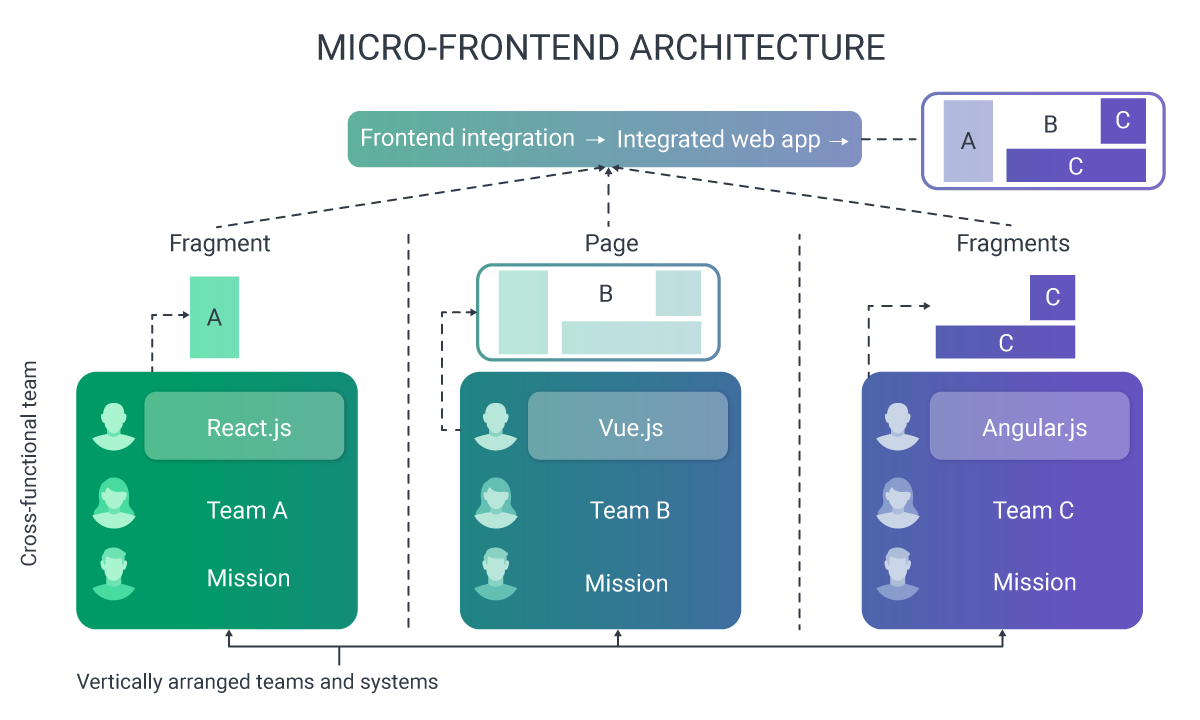
What is Micro Frontend? Why It Matters in Modern Web Development
In today’s fast-moving digital world, building scalable and maintainable web applications is a real challenge. That’s where Micro Frontend architecture comes in.
🔍 What is Micro Frontend?
Micro Frontend is an approach where a frontend application is divided into smaller, independent pieces. Each piece (or module) is developed, tested, and deployed separately—just like microservices in backend development.
Instead of one large frontend codebase, you have multiple smaller apps working together seamlessly.
💡 Why do we use Micro Frontends?
To manage large and complex applications easily
To allow multiple teams to work independently
To speed up development and deployment cycles
To adopt different technologies within the same application
🌟 Key Benefits
✅ Scalability – Easily scale teams and features
✅ Faster Development – Parallel development across teams
✅ Technology Flexibility – Use React, Angular, Vue, etc. in the same project
✅ Better Maintainability – Smaller codebases are easier to manage
✅ Independent Deployments – No need to redeploy the entire app for small changes
🏢 Companies Using Micro Frontends
Many leading tech companies have adopted this architecture:
1.Spotify
2.IKEA
3.Zalando
4.DAZN
5.Amazon
📌 Final Thought
Micro Frontends are not just a trend—they are becoming a standard for building large-scale frontend systems. If you’re working on enterprise-level applications, this approach can significantly improve productivity, flexibility, and performance.
 Bitcoin
  Ethereum
  Tether
  BNB
BNB  XRP
XRP  USDC
USDC  Solana
  TRON
TRON  Lido Staked Ether
  Figure Heloc
  Dogecoin
  Hyperliquid
  USDS
USDS  Zcash
Zcash  LEO Token
  Wrapped stETH
  Cardano
  Monero
  Wrapped Bitcoin
  Bitcoin Cash
  Binance Bridged USDT (BNB Smart Chain)
  Chainlink
  Wrapped Beacon ETH
  WhiteBIT Coin
  Canton
  Toncoin
  Wrapped eETH
  Stellar
  USD1
USD1  sUSDS
sUSDS  Ethena USDe
  Dai
Dai  Sui
Sui  Coinbase Wrapped BTC
  Litecoin
  Avalanche
  Hedera
  WETH
WETH  MemeCore
  Rain
Rain  NEAR Protocol
  USDT0
USDT0  PayPal USD
  Shiba Inu
  Cronos
  Circle USYC
  Global Dollar
  Bittensor
  Tether Gold
  Ethena Staked USDe