
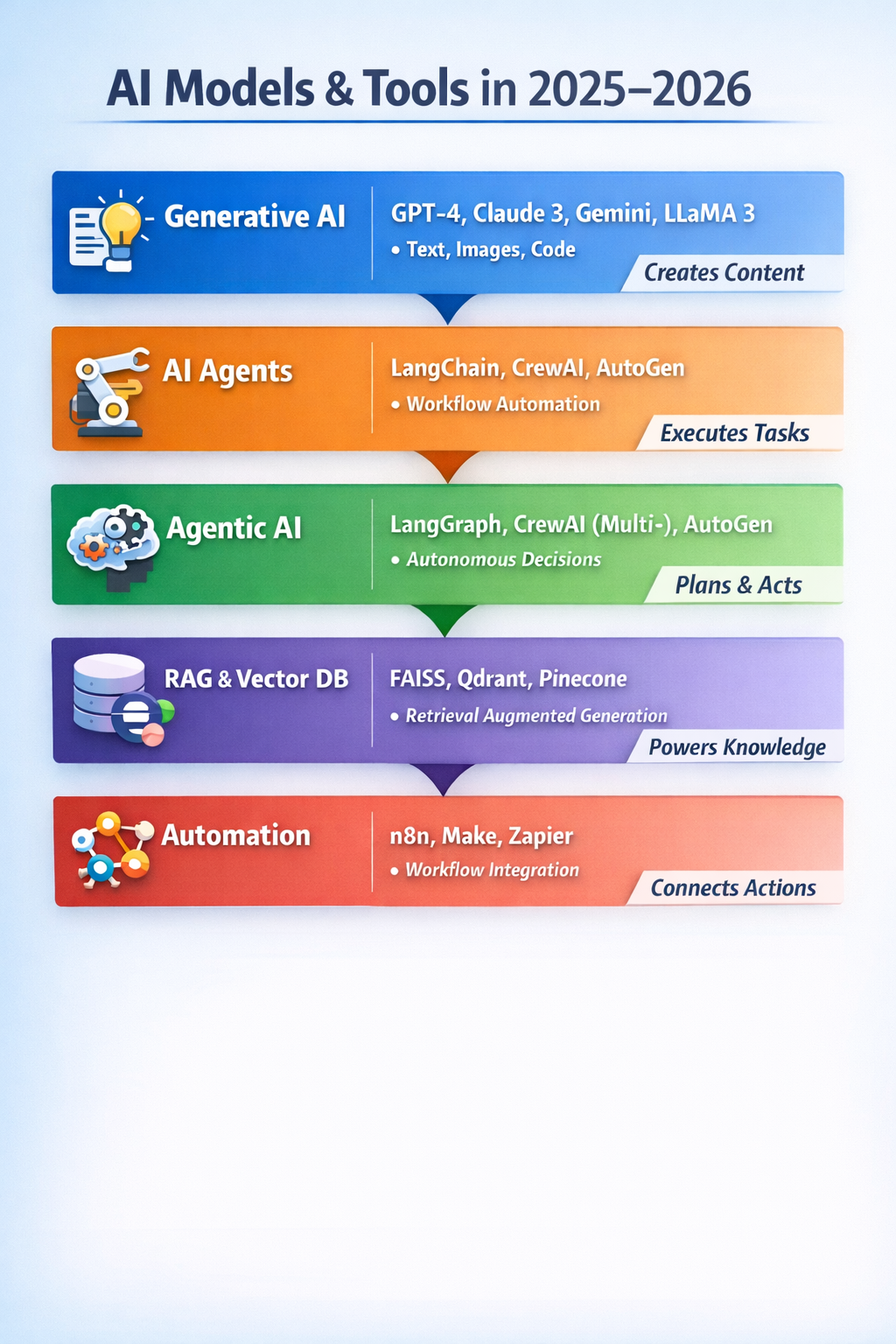
Generative AI vs AI Agents vs Agentic AI
(Why this distinction matters in 2025–2026)
Most people use these terms interchangeably — but they are very different.
1️⃣ Generative AI:
What it does: Creates content
Text, images, code, audio
Responds only when prompted
No memory of goals
No decision-making
Example:
“Write a LinkedIn post about marketing AI.”
📌 Think of it as a very smart content creator.
🔧 Popular Models: (Generate Text,Images,code,content generation,chatbot)
1.GPT-4 / GPT-4.1 / GPT-4o (OpenAI)
2.Claude 3.5 Sonnet / Opus (Anthropic)
3.Gemini 1.5 Pro / Flash (Google)
4.LLaMA 3 / 3.1 (Meta – Open source)
5.Mistral Large / Mixtral (Mistral AI)
6.Qwen 2.5 / Qwen Max (Alibaba)
7.FLAN-T5 / T5 (Open-source NLP)
2️⃣ AI Agents:
What they do: Execute tasks
Follow predefined workflows
Use tools (APIs, DBs, CRM)
Still reactive, not proactive
Limited autonomy
Example:
“Fetch analytics → generate report → email manager.”
📌 Think of it as a skilled assistant.
🧰 Agent Frameworks & Tools: (API,DB,Automation tools like n8n)
1.LangChain
2.CrewAI
3.AutoGen (Microsoft)
4.OpenAI Assistants API
5.Semantic Kernel
6.Haystack
7.n8n
3️⃣ Agentic AI:
What it does: Plans, decides, and acts autonomously
Has goals
Chooses tools dynamically
Coordinates multiple agents
Learns from outcomes
Works without constant prompts
Example:
“Traffic dropped → analyze cause → update content → run campaign → measure ROI → improve next action.”
📌 Think of it as a self-driving system.
🧠 Orchestration Frameworks:
1.LangGraph ⭐ (most production-ready)
2.CrewAI (multi-agent mode)
3.AutoGen (multi-agent orchestration)
4.OpenAI Swarm
5.DSPy (self-optimizing prompts)
#agenticai #aiagents #generativeai #aistack #aiarchitecture #llm #automation #futureofwork #marketingai
 Bitcoin
  Ethereum
  Tether
  BNB
BNB  XRP
XRP  USDC
USDC  Solana
  TRON
TRON  Lido Staked Ether
  Figure Heloc
  Dogecoin
  WhiteBIT Coin
  USDS
USDS  Cardano
  Bitcoin Cash
  Wrapped stETH
  LEO Token
  Hyperliquid
  Wrapped Bitcoin
  Monero
  Binance Bridged USDT (BNB Smart Chain)
  Chainlink
  Ethena USDe
  Wrapped Beacon ETH
  Canton
  Stellar
  Wrapped eETH
  USD1
USD1  Dai
Dai  sUSDS
sUSDS  Rain
Rain  PayPal USD
  Hedera
  Coinbase Wrapped BTC
  Litecoin
  Avalanche
  Sui
Sui  WETH
WETH  Zcash
Zcash  Toncoin
  Shiba Inu
  USDT0
USDT0  Cronos
  Tether Gold
  World Liberty Financial
  MemeCore
  PAX Gold
  Polkadot
  Uniswap
  Ethena Staked USDe