
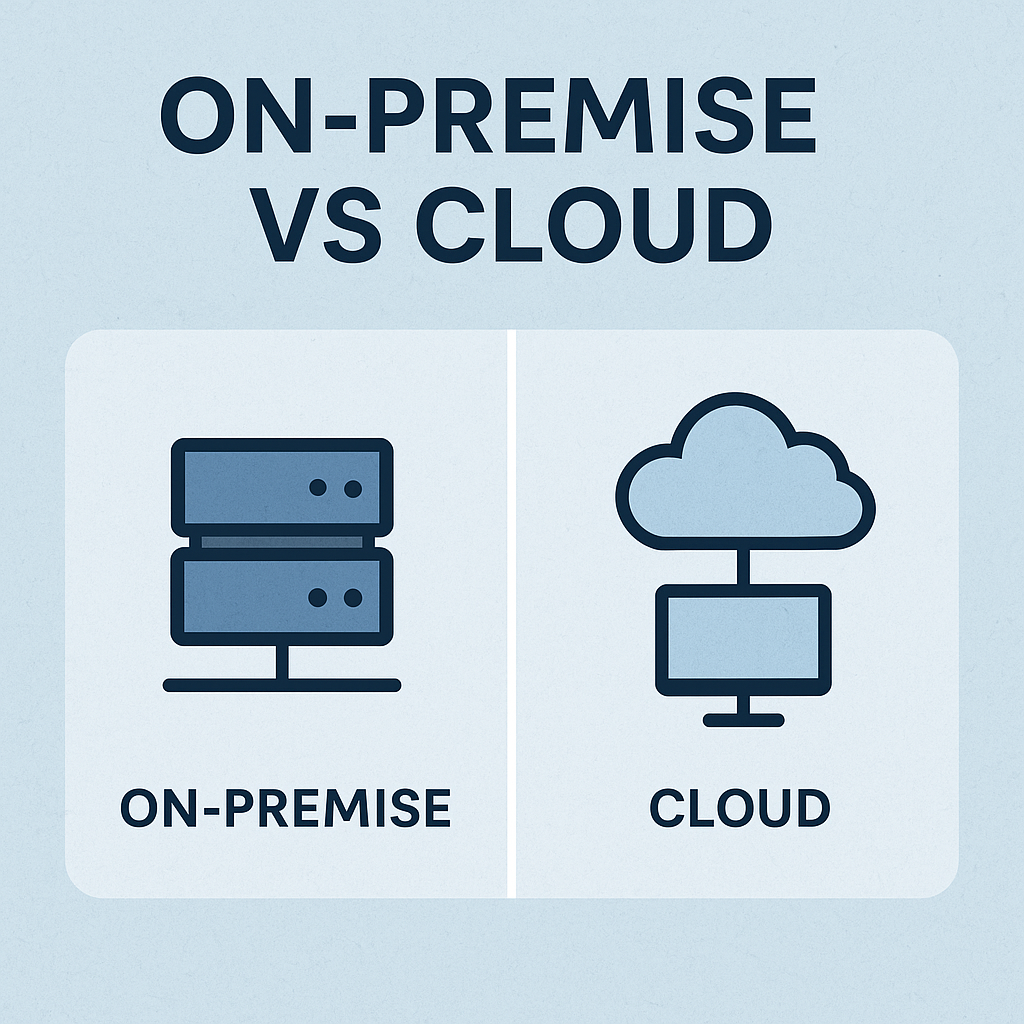
On-Premise vs Cloud: The Architectural Reality Behind the Decision
Most discussions around “On-Premise vs Cloud” oversimplify a deeply technical choice.
In practice, this decision impacts latency models, security posture, scalability ceilings, operational risk, and long-term cost architecture.
Here’s how engineering teams should evaluate the trade-offs:
🏢 On-Premise (Bare Metal / Virtualized Environments)
Full control over network topology, firewall layers, and segmentation
Predictable performance for low-latency, high-IOPS workloads
Customizable IAM, encryption, and compliance frameworks
However: Limited elasticity, higher MTTR, hardware lifecycle overhead, and CAPEX-heavy scaling
🏢 On-Premise — Advantages
✔ Full Control Over Hardware & Network
✔ Low Latency for Localized Workloads
✔ Custom Security Hardening
✔ No Dependency on Internet Connectivity
🏢 On-Premise — Disadvantages
✖ High CAPEX Costs
✖ Scalability Limitations
✖ Operational Overhead
✖ Higher MTTR (Mean Time to Recovery)
☁️ Cloud (AWS / Azure / GCP/Alibaba/Huawei)
Elastic compute scaling, autoscaling groups, and distributed storage
Built-in zero-trust security, managed identities, threat analytics, and DDoS protection
Event-driven architectures using serverless, container orchestration, and managed services
However: Requires strong governance to avoid drift, overprovisioning, and unpredictable OPEX
☁️ Cloud — Advantages
✔ Elastic Scalability
✔ Operational Cost Model (OPEX)
✔ Built-in Security & Compliance
✔ Global Reach & High Availability
✔ Accelerated Innovation
☁️ Cloud — Disadvantages
✖ OPEX Sprawl Without Governance
✖ Vendor Lock-In
✖ Latency & Data Egress Costs
✖ Shared Responsibility Model
🔧 What Senior Engineers Actually Do Today:
We architect hybrid environments that blend both worlds:
Sensitive or latency-critical workloads stay on-prem
Compute-heavy, burst workloads, AI pipelines, and data analytics move cloud-side
Unified monitoring via SIEM + centralized identity (Entra ID / IAM)
Automated CI/CD deployed across both infrastructure layers
📌 The Strategic Question Isn’t “Which Is Better?”
It’s:
How do we design a workload placement strategy that optimizes performance, cost, security, and operational resilience across both ecosystems?
If you’re designing or modernizing infrastructure in 2025, the architecture must be cloud-aware, policy-driven, and scalable across zones, regions, and environments.
Happy to discuss hybrid cloud blueprints, security baselines, or workload orchestration patterns anytime.
#CloudComputing #OnPremise #HybridCloud #SystemsArchitecture #CyberSecurity #DevOpsEngineering #CloudMigration #InfrastructureAsCode #ZeroTrust #EnterpriseIT #TechnicalLeadership #SolutionArchitecture
 Bitcoin
  Ethereum
  Tether
  XRP
XRP  BNB
BNB  USDC
USDC  Solana
  TRON
TRON  Lido Staked Ether
  Figure Heloc
  Dogecoin
  USDS
USDS  WhiteBIT Coin
  Cardano
  Hyperliquid
  Wrapped stETH
  Bitcoin Cash
  LEO Token
  Wrapped Bitcoin
  Monero
  Binance Bridged USDT (BNB Smart Chain)
  Chainlink
  Ethena USDe
  Wrapped Beacon ETH
  Canton
  Stellar
  Wrapped eETH
  USD1
USD1  Dai
Dai  sUSDS
sUSDS  Litecoin
  Rain
Rain  Avalanche
  Coinbase Wrapped BTC
  PayPal USD
  Hedera
  Zcash
Zcash  WETH
WETH  Sui
Sui  Shiba Inu
  Cronos
  USDT0
USDT0  Toncoin
  MemeCore
  World Liberty Financial
  Bittensor
  Tether Gold
  Polkadot
  Mantle
  Ethena Staked USDe